
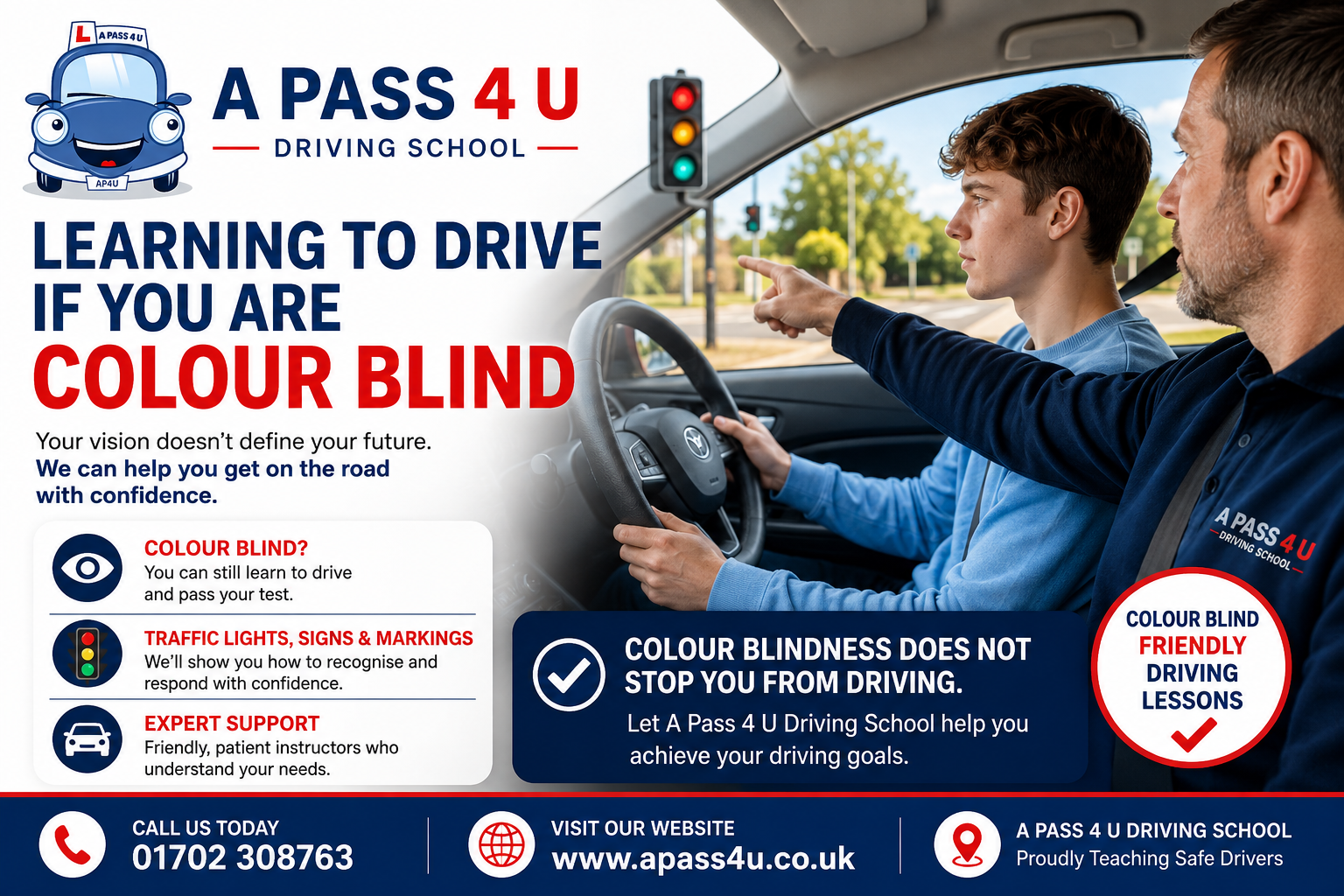
Learning to Drive If You Are Colour Blind: What You Need to Know
Can you learn to drive if you are colour blind? Absolutely. If you have colour blindness and are thinking about learning to drive, you may be wondering whether it will affect your ability to get a licence, pass your driving test or safely drive on the road.
The good news is that colour blindness does not automatically prevent you from driving in the UK. According to the DVLA, people with colour blindness can drive cars and motorcycles and do not need to notify the DVLA simply because they are colour blind.
At A Pass 4 U Driving School, we understand that every learner is different. If you’re colour blind, your instructor can help you develop safe, practical ways of recognising road signs, traffic lights and other important information while building your confidence behind the wheel.
Can You Drive If You Are Colour Blind?
Yes. For ordinary car and motorcycle licences (Group 1), colour blindness is not, by itself, a reason you cannot drive and you do not need to tell the DVLA that you are colour blind.
The important point is that you still need to meet the normal eyesight requirements for driving.
For example, you must be able to read a vehicle registration plate from 20 metres and meet the required standards for visual acuity and field of vision.
So, if you are colour blind but have otherwise adequate vision, you can learn to drive, take your practical driving test and drive independently once you have passed.
What Is Colour Blindness?
Colour blindness, sometimes called colour vision deficiency, means that you may see certain colours differently from other people.
There are different types and levels of colour blindness. Some people have difficulty distinguishing between particular shades, while others may find it harder to differentiate between colours such as red and green.
This can understandably make some new drivers concerned about traffic lights and road signs.
However, driving isn’t based on colour alone.
When you learn with a professional driving instructor, you’ll develop an understanding of traffic lights, road signs, road markings, position, speed and other visual information as part of your overall driving skills.
How Do Colour Blind Drivers Recognise Traffic Lights?
One of the most common concerns we hear is:
“How will I know which traffic light is which if I can’t easily distinguish red, amber and green?”
Traffic lights are designed so that their position and sequence provide additional information, rather than requiring drivers to rely solely on identifying the colour.
A standard traffic signal is arranged vertically, with:
- Red at the top
- Amber in the middle
- Green at the bottom
This means that learning the position of each light can provide an additional reference if distinguishing the colours themselves is difficult.
You should never rely on guessing the colour of a traffic light. Instead, your instructor can help you become familiar with the layout and sequence of traffic signals so that you can respond safely and confidently.
Tips for Learning to Drive When You Are Colour Blind
Learning to drive is a process for everyone, and having colour blindness simply means you may want to pay particular attention to certain aspects of your training.
1. Tell Your Driving Instructor
Let your instructor know that you’re colour blind when you start your lessons.
There is no need to feel embarrassed about it. Colour blindness is relatively common, and a good instructor will work with you to make sure you understand the visual information you need when driving.
At A Pass 4 U Driving School, we can adapt the way we explain things to suit the individual learner.
2. Learn Road Signs by Shape and Meaning
Road signs don’t rely entirely on colour.
Their shape, symbols, wording and positioning can all provide important information.
For example, different categories of road signs have distinctive shapes and designs. Learning what signs mean rather than relying solely on their colours is an important part of becoming a confident driver.
Your instructor can help you practise identifying signs while you’re driving so that recognising them becomes second nature.
3. Understand Road Markings
Road markings are another important part of learning to drive.
Rather than focusing only on colour, learn what different road markings mean, where they appear and how they affect your driving.
Your instructor will help you understand markings such as:
- Stop lines
- Give Way markings
- Lane markings
- Yellow lines
- Box junctions
- Hazard warning lines
- Parking restrictions
Understanding the rules behind road markings is far more important than simply identifying a particular colour.
4. Practise in Different Conditions
As your driving improves, you’ll encounter different environments and lighting conditions.
Your instructor can help you experience:
- Busy town-centre roads
- Residential streets
- Roundabouts
- Dual carriageways
- Different types of junction
- Daytime driving
- Poor-weather conditions
- Night-time driving, where appropriate
This can help you become comfortable processing information from the road environment rather than relying on colour alone.
5. Ask Questions
If you’re unsure about something during a lesson, ask.
It’s much better to say “I’m not sure what that means” and get clarification than to make an assumption.
Learning to drive is about developing good judgement, awareness and decision-making. Asking questions is part of the learning process.
Will Being Colour Blind Affect Your Driving Test?
Being colour blind does not automatically stop you from taking or passing a car driving test.
The practical driving test includes an eyesight check at the beginning. You need to correctly read a number plate from the required distance. If you cannot meet the eyesight standard, the test will not continue.
Importantly, the eyesight requirement is not a colour vision test. The DVLA’s guidance specifically states that people with colour blindness may drive and do not need to notify the DVLA simply because of their colour blindness.
You will still be expected to demonstrate the same standard of safe driving as any other learner.
That includes showing that you can:
- Make effective observations
- Respond appropriately to traffic signs and signals
- Use mirrors correctly
- Maintain suitable speed
- Position your vehicle safely
- Anticipate hazards
- Make safe decisions
- Follow road signs and road markings
- Complete the required manoeuvres safely
What If You’re Worried About Traffic Lights?
If traffic lights are your biggest concern, don’t let that put you off learning.
Tell your instructor and spend some time specifically practising approaches to traffic signals.
You can learn to consider the position of the lights, their sequence, other road users and the overall traffic situation rather than relying entirely on colour perception.
Your instructor can also help you understand what to look for when approaching a set of lights and how to respond when they change.
The aim is to make your decisions based on a complete picture of the road, not one visual cue.
Do You Need to Tell the DVLA You Are Colour Blind?
For a standard Group 1 car or motorcycle licence, colour blindness on its own does not need to be reported to the DVLA.
However, colour blindness is different from other eyesight conditions.
If you have another eye condition that affects your ability to meet the legal driving eyesight standards, you may need to tell the DVLA. If you’re unsure, GOV.UK recommends checking the relevant guidance or getting advice from an optician, GP or eye specialist.
Can You Learn to Drive With A Pass 4 U Driving School?
Yes. If you’re looking for driving lessons and are colour blind, there’s no reason for colour blindness alone to stop you from getting started.
At A Pass 4 U Driving School, our aim is to help learners become safe, confident and independent drivers. Your lessons can be tailored to your individual needs and learning style.
We can help you build your skills progressively, from your first lesson through to test preparation.
Our private practice guidance also recommends working with a suitable supervising driver, planning routes around the skills you want to practise and keeping track of your progress between lessons.
Learning to Drive If You Are Colour Blind: The Bottom Line
If you’re colour blind and wondering whether you can learn to drive, don’t let colour blindness stop you from getting started.
For car and motorcycle drivers in the UK, colour blindness itself does not prevent you from driving and does not need to be reported to the DVLA.
The key is learning how to process all the information available to you on the road, including the position and sequence of traffic lights, road signs, markings, vehicle movements and hazards.
With the right instruction and plenty of practice, you can develop the skills and confidence needed to become a safe driver.
Ready to start learning to drive? Contact A Pass 4 U Driving School today to discuss your driving lessons.
A Pass 4 U Driving School
Phone: 01702 308763
Website: www.apass4u.co.uk
Frequently Asked Questions
Can colour blind people drive in the UK?
Yes. Colour blindness does not prevent you from driving a car or motorcycle, and you do not need to notify the DVLA simply because you are colour blind.
Can you pass your driving test if you are colour blind?
Yes. Colour blindness itself does not prevent you from passing the UK car driving test. You must still meet the normal eyesight requirements and demonstrate the required standard of safe driving.
Can colour blind people see traffic lights?
Colour blindness affects people differently. Some people can distinguish traffic-light colours with little difficulty, while others may find certain colours harder to differentiate. Drivers can also use the position and sequence of traffic lights as important additional information.
Do I have to tell my driving instructor I’m colour blind?
You don’t have to, but it’s a good idea. Letting your instructor know means they can understand your needs and provide explanations and practice that help you feel more confident.
Do I need to tell the DVLA I’m colour blind?
For a Group 1 car or motorcycle licence, colour blindness alone does not need to be reported to the DVLA.
What eyesight test do I need to pass to drive?
For a standard car licence, you must be able to read a registration plate from 20 metres and meet the required visual acuity and field-of-vision standards.