
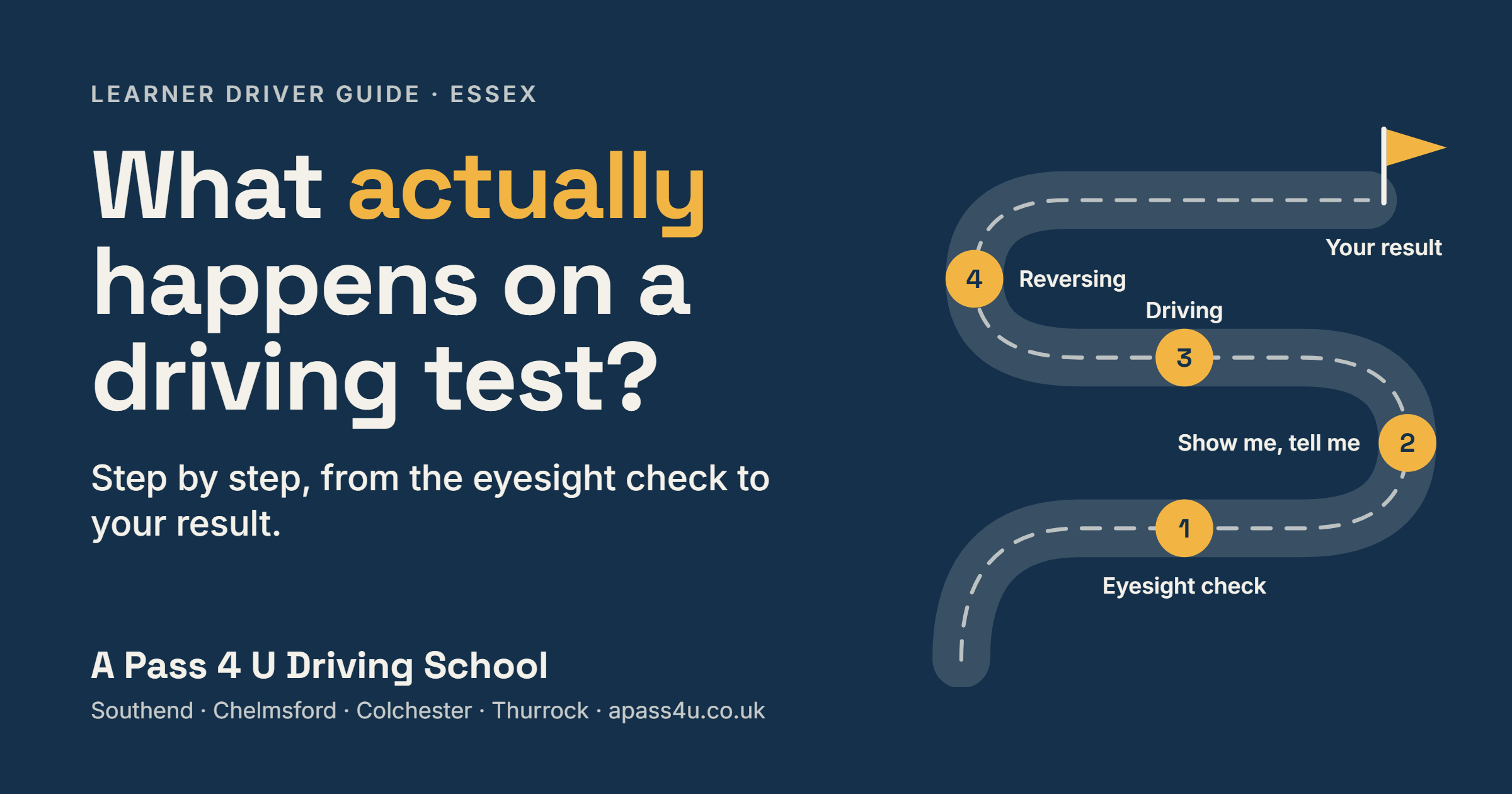
Your practical driving test is around 30 to 40 minutes of driving, plus a few checks before and after. It has four parts: an eyesight check, two vehicle safety questions, general and independent driving, and one reversing exercise. The test is the same in a manual or an automatic.
Knowing exactly what will happen takes away a lot of the fear. Here is a step-by-step walkthrough from A Pass 4 U, written for learners testing at Southend-on-Sea, Chelmsford, Colchester, Basildon and Tilbury in Thurrock.
Arriving at the test centre
Arrive around 10 minutes before your test time. Most A Pass 4 U Driving School learners have a warm-up lesson first and arrive with their instructor.
You must bring:
- your UK photocard driving licence (provisional)
- your theory test pass certificate, if you have it (the examiner can check you have passed)
- a car, usually your instructor’s dual-control car
If you forget your licence, your test will be cancelled and you will not get your money back.
The examiner will come to the waiting room, check your licence and ask you to sign a declaration about your insurance and residency. They will also ask whether you want your instructor to sit in the back and to hear your result.
Local test centres and recent pass rates
| Area | Test centre | Address | Pass rate 2024-25 |
|---|---|---|---|
| Thurrock | Tilbury | Montana House, Russell Road, RM18 7AE | 49.1% |
| Southend-on-Sea | Southend-on-Sea | The Tickfield Centre, Tickfield Avenue, SS2 6LL | 48.1% |
| Colchester | Colchester | Grange Way, CO2 8HF | 48.0% |
| Basildon | Basildon | Paycocke Road, SS14 3JS | 45.6% |
| Chelmsford | Chelmsford (Hanbury Road) | Hanbury Road, Widford Industrial Estate, CM1 3DR | 44.7% |
The national average for 2024-25 was 48.7%, so all four centres sit close to it. Pass rates are DVSA figures as reported by PassRates.uk and Driving Data UK.
Part 1: the eyesight check
Before you reach the car, the examiner will point to a parked vehicle and ask you to read its number plate. The distance is 20 metres for a new-style plate (such as AB51 ABC) and 20.5 metres for an old-style plate.
This is the only part you cannot recover from. If you cannot read the plate, the test ends there. If you need glasses or contact lenses to drive, wear them.
Part 2: show me, tell me questions
You will be asked two vehicle safety questions:
- One “tell me” question at the start, before you drive. For example: “Tell me how you’d check that the brakes are working before starting a journey.”
- One “show me” question while you are driving. For example: “Show me how you’d wash and clean the front windscreen.”
A wrong answer is usually just one minor fault. Even so, these are easy marks, and your A Pass 4 U instructor will practise every question with you. The full list is on GOV.UK.
Part 3: general driving on Essex roads
You will drive in a range of road and traffic conditions, but never on a motorway. The examiner gives clear directions in good time, such as “At the roundabout, take the second exit.”
Along the way you will be asked to:
- pull up normally at the side of the road
- pull out from behind a parked vehicle
- do a hill start
- possibly carry out an emergency stop
DVSA does not publish test routes, so nobody can tell you the exact roads. What we can tell you is the type of driving each area tends to involve:
- Southend-on-Sea: busy town roundabouts, residential streets with parked cars, and fast A-roads like the A127.
- Chelmsford: multi-lane roundabouts, the edge of the city centre and links towards the A12.
- Colchester: a mix of town-centre junctions, roundabouts and faster roads on the outskirts.
- Basildon: a new town built around roundabouts, with dual carriageways such as the A127 and A13 close by.
- Tilbury and Thurrock: dual carriageways, heavy goods traffic around the port and quieter residential estates.
This is why we practise around your test centre in the final weeks of your lessons.
Part 3 continued: independent driving
For 20 to 35 minutes you will drive without turn-by-turn directions from the examiner. You will follow either:
- directions from a sat nav, which the examiner sets up (you cannot use your own)
- traffic signs
- or a mix of both
The examiner tells you which one to follow. If a sign is hidden behind a tree or van, they will direct you until the next one.
Going the wrong way is not a fault. If you miss a turning, the examiner will help you back on route. What matters is that you drive safely while doing it. Never swerve across lanes to make an exit you have nearly missed.
Part 4: the reversing exercise and emergency stop
You will be asked to do one of these three manoeuvres:
- Parallel park at the side of the road behind another car.
- Bay park in a car park, either driving in and reversing out, or reversing in and driving out. The examiner will tell you which.
- Pull up on the right, reverse about two car lengths, then rejoin the traffic.
Bay parking often happens at the test centre itself, either at the start or end of the test.
Some tests also include an emergency stop. The examiner will ask you to pull over, explain what will happen, then give a clear signal. Brake firmly and quickly, keep control of the car, and do proper all-round checks before moving off again.
Faults and your result
The examiner marks three types of fault:
| Fault type | What it means | Effect on your result |
|---|---|---|
| Driving fault (“minor”) | Not potentially dangerous | You can have up to 15 and still pass |
| Serious fault | Something potentially dangerous | One means a fail |
| Dangerous fault | Actual danger to you, the examiner, the public or property | One means a fail |
Repeating the same minor fault can turn it into a serious one, so patterns matter more than one-off slips.
If you make a mistake, keep going. The examiner only stops a test early if your driving is a danger to other road users.
Back at the test centre, the examiner tells you whether you passed and explains any faults. Your instructor can listen in if you want.
- If you pass: the examiner can send off for your full licence automatically. You can drive straight away once you have the right insurance.
- If you do not pass: you can book again, choosing a date at least 10 working days away. Your feedback shows exactly what to work on.
Driving test FAQs for Essex learners
How long is the driving test? Around 35 minutes of driving. Allow about an hour for the whole appointment, including checks and feedback.
Can I see the test routes for Southend, Chelmsford, Colchester, Basildon or Tilbury? No. DVSA does not publish routes. Practising the roads around your centre is the best preparation.
Can my driving instructor book my test? Not any more. Since 12 May 2026, only the learner can book, change or cancel their own car driving test on GOV.UK. Your instructor can still advise you on when you are ready.
How many times can I change my test date? Up to two times per booking, under rules in force since 31 March 2026.
Can I take my test in my own car? Yes, if it meets DVSA’s rules. Most learners use their instructor’s dual-control car because they know it well.
Book your lessons with A Pass 4 U
A Pass 4 U teaches learner drivers across Southend-on-Sea, Chelmsford, Colchester and Thurrock. We prepare you for every part of the test, from show me, tell me questions to sat nav driving on the roads around your local centre, with mock tests so nothing on the day comes as a surprise.
Visit www.apass4u.co.uk or email apass4u@yahoo.co.uk to get started or send us an enquiry and we will happily call you back Make an Enquiry
Feeling anxious about the big day? Read our guide to beating driving test nerves in Essex.