
Choosing between manual and automatic driving lessons is one of the first decisions you’ll make when learning to drive. Both options can give you the skills and confidence you need to become a safe, independent driver, but the learning experience can be quite different.
If you’re looking for driving lessons in Thurrock, Basildon or the surrounding areas of Essex, A Pass 4 U driving School offers both manual and automatic driving lessons, allowing you to choose the type of vehicle that best suits your needs.
But which is right for you? Let’s look at the main differences.
What is the difference between a manual and automatic car?
The biggest difference is how the vehicle changes gear.
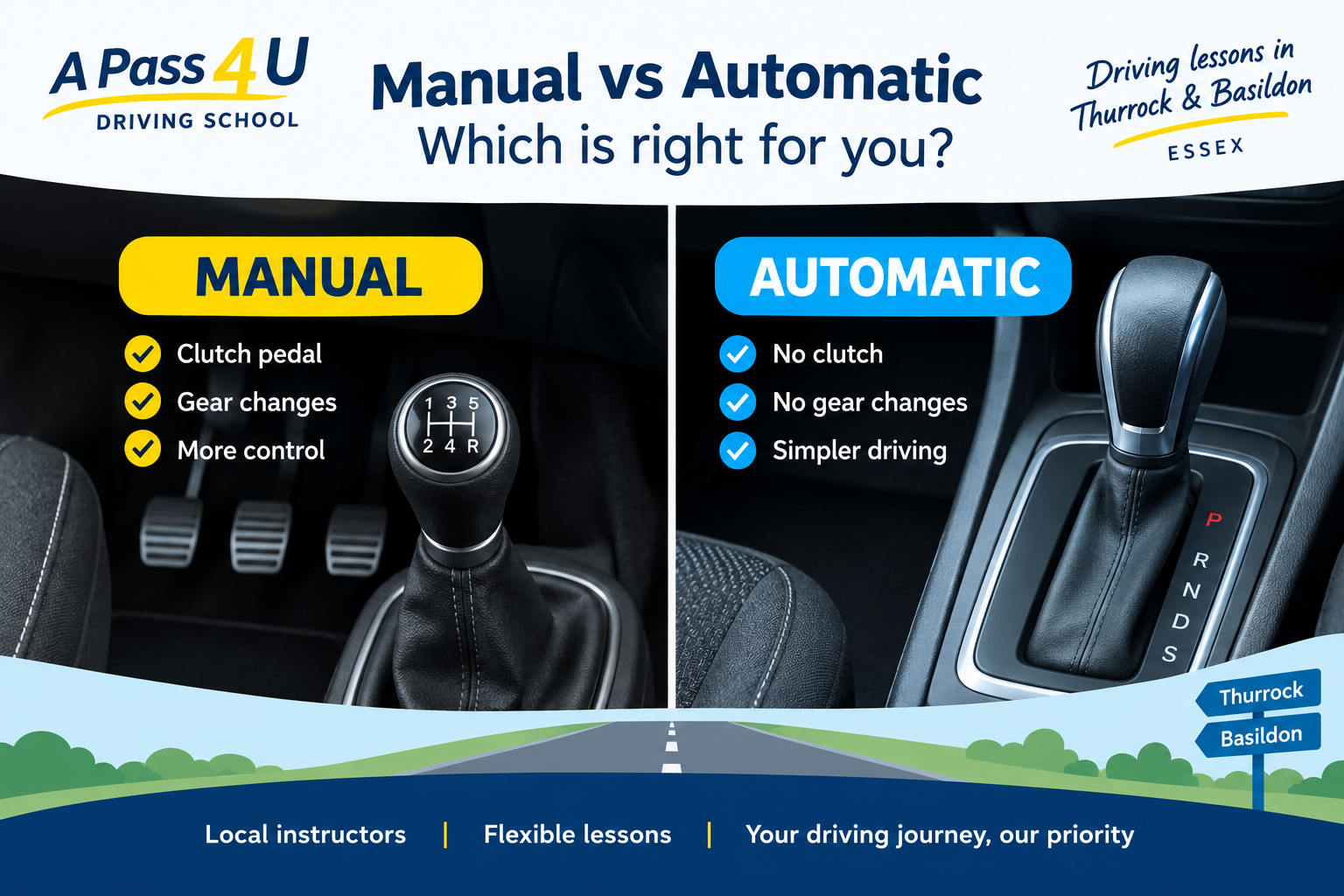
A manual car has a clutch pedal and a gear stick. As you accelerate and slow down, you need to select the appropriate gear and operate the clutch smoothly.
An automatic car takes care of gear changes for you. There is no clutch pedal and you don’t need to manually select gears while driving.
This fundamental difference can have a significant effect on your experience as a learner.
Learning to drive a manual car
For many years, learning in a manual car has been the traditional route for learner drivers in the UK.
Manual driving gives you more involvement in controlling the car. You’ll learn how to:
- Operate the clutch and find the biting point
- Change gears smoothly
- Select the appropriate gear for different situations
- Coordinate the clutch, accelerator and brakes
- Change gear while dealing with traffic and junctions
- Control the vehicle on hills
- Make appropriate gear choices as road conditions change
For some learners, this extra involvement feels rewarding and gives them a strong understanding of how a car works.
The advantages of learning in a manual
One of the biggest advantages of learning in a manual is licence flexibility.
If you pass your practical driving test in a manual car, you can generally drive both manual and automatic cars within the relevant licence category.
Manual cars can also give you greater choice when looking for a used car, particularly if you’re buying your first vehicle.
Another advantage is that you’ll develop experience controlling the clutch and gears, which can be useful if you eventually drive different types of vehicles.
What can make manual lessons challenging?
For a new driver, there is a lot to think about.
You’re learning road positioning, observation, steering, mirrors, signalling, speed control and anticipation — while also remembering which gear you should be in.
At first, coordinating the clutch and accelerator can feel difficult. You may stall the car occasionally, particularly when moving away from junctions or on hills.
Don’t worry — this is completely normal when learning to drive.
With practice, gear changes and clutch control gradually become more instinctive, allowing you to concentrate more on the road around you.
Learning to drive an automatic car
Automatic driving lessons are becoming increasingly popular with learners who want a simpler driving experience, they are also a pound or 2 more expensive per hour than manual lessons.
With an automatic vehicle, the car selects the gears for you. You simply use the accelerator and brake pedals and concentrate on controlling the vehicle and responding to the road.
There is no clutch pedal and no manual gear changing.
That means you can devote more of your attention to:
- Observation
- Planning ahead
- Road positioning
- Junctions and roundabouts
- Speed control
- Other road users
- Developing confidence in traffic
This can be particularly appealing to nervous learners or anyone who finds clutch control and gear changes stressful e.g. learners with dyslexia, dyspraxia or mild autism.
The advantages of learning in an automatic
The biggest advantage is simplicity.
Instead of learning clutch control and gear changes at the same time as everything else, you can concentrate on the fundamentals of safe driving.
Automatic cars can also be particularly comfortable in busy, stop-start traffic. This can be useful when learning around busy urban areas such as Basildon and Thurrock, where learners encounter a mixture of residential roads, busy junctions, roundabouts and larger roads.
A Pass 4 U’s local driving lessons in Basildon, for example, are designed around the area’s varied road network, including its numerous roundabouts and connections to roads such as the A13 and A127.
The same principle applies around Thurrock, where learners can experience town roads, residential areas, larger junctions and dual carriageways during their tuition. A Pass 4 U offers both manual and automatic lessons across the wider Thurrock area.
Is an automatic easier to learn than a manual?
For many learners, yes — but that doesn’t necessarily mean an automatic is the right choice for everyone.
Removing the clutch and gear changes means there are fewer physical controls to master.
This can allow some learners to progress more quickly because they can focus on observation, planning and decision-making from an earlier stage.
However, learning to drive is still a significant skill regardless of the type of vehicle you choose.
You still need to learn how to:
- Read the road
- Anticipate hazards
- Use mirrors effectively
- Position your vehicle correctly
- Deal with junctions and roundabouts
- Follow road signs and markings
- Control your speed
- Make safe decisions
- Drive independently
An automatic doesn’t remove these challenges. It simply removes the need to operate the clutch and manually change gears.
Manual vs automatic: a quick comparison
| Manual | Automatic | |
| Clutch pedal | Yes | No |
| Manual gear changes | Yes | No |
| Can be easier initially | For some learners | Often |
| Licence flexibility | Greater | Restricted to automatics if test is taken in an automatic |
| Stop-start traffic | Requires clutch/gear control | Generally simpler |
| Good for nervous learners | Depends on the learner | Often a popular choice |
| Greater involvement in vehicle control | Yes | Less |
| Suitable for learning in Thurrock & Basildon | Yes | Yes |
The most important thing is to choose the option that fits you, rather than choosing based on what someone else thinks you should learn in and when taking your DVSA practical test you will have the same test..